
Beschreibung
Erhaltung: cf. Jesus Vico S.A., Auction 169, 26 June 2024, Lot 120 (in xf- + 20%) | Abkürzungen
Katalognummer: Flavia Julia
Durchmesser: 34,00 mm
weight 28,83gr. | bronze Ø 34mm.
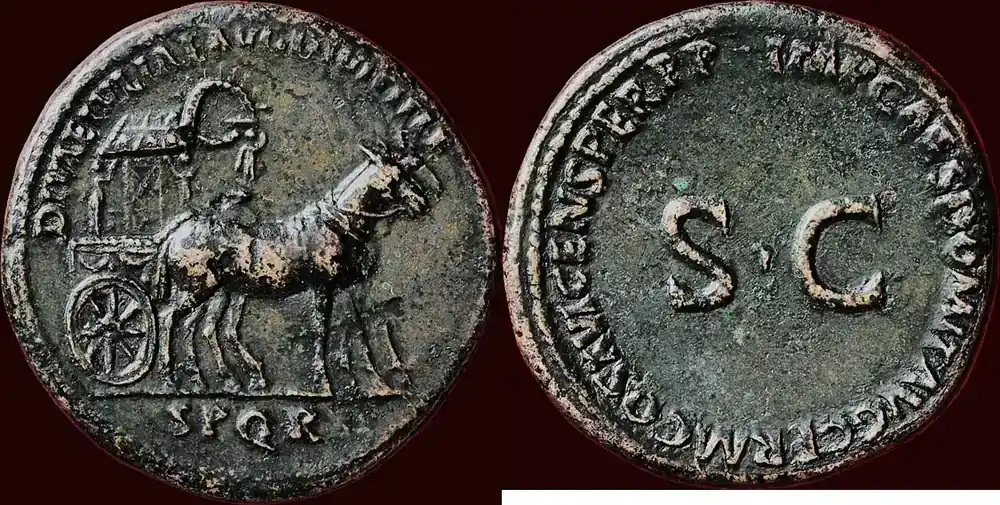
obv. Ornate carpentum drawn by two mules to right statuettes at
each corner of cart bed supporting an arched and elaborately-decorated
canopy side panel between statuettes decorated with a dancing figure
side panel of bed decorated with wreaths, the legend DIVAE IVLIAE
AVG DIVI TITI F above, S P Q R in exergue
rev. Large S C , surrounded by the legend IMP CAES DOMIT AVG
GERM COS XVI CENS PER P P
Flavia Julia (also nicknamed Julia Titi) was born in Rome circa 63 AD to Titus and his first wife Arrecina Tertulla, she was named for Tertullas mother Julia Ursa. Her mother was either divorced or died when Julia was an infant. Her father later remarried to Marcia Furnilla with whom he had another daughter who is presumed to have died young. In 65, after the failure of the Pisonian conspiracy, the family of Furnilla was disfavored by Nero. Julias father, Titus concluded that he did not want to be connected with any potential plotters and ended his marriage to Julias step-mother. Julia was likely raised by her maternal grandmother and the wet nurse Phyllis (who had already reared Julias uncle Domitianus as a child). When growing up, Titus offered her in marriage to his brother Domitianus, but he refused because of his infatuation with Domitia Longina. Titus arranged a marriage with her second paternal cousin Flavius Sabinus. This was a grandson of a brother of Vespasianus, also called Flavius Sabinus. A few years after the marriage, however, an affair developed between Julia and Domitianus. By 83 this had become so serious that Domitianus divorced his wife Domitia and had her exiled. In 84, Julias husband also suffered and was executed by Domitianus on a senseless charge. After the death of her husband Julia lived in the palace with her uncle and his wife Domitia Longina. Ancient historians report stories that Julia was seduced by her uncle and died, probably 91 AD, having an abortion forced upon her by him. Julia was deified after her death at age 37 and Martial wrote a poem where in he praised her and wished for her to become the spiritual guardian of the (hoped for) future son of Domitianus and Domitia whom he wished to be named Julius in her honor. Following the downfall of her uncle Domitianus, their wet nurse Phyllis mixed his ashes with those of Julia to ensure that his remains would not be thrown away. The carpentum was a two-wheeled carriage with an arched covering. The use of it is mentioned in very early times at Rome, but only by privileged persons, at least within the walls. The currus arcuatus assigned by Numa to the Flamines (Liv. 1.21) is no doubt the same as the carpentum which was the travelling carriage of the elder Tarquin while still a private person (id. 34), and in which Tullia drove through the streets (id. 48). In its original form it must have been simply a covered cart, thus distinguished from the plaustrum or open cart. The use of carriages in the city was entirely forbidden during the whole of the republic and for the first two centuries of the empire. The permission granted to Lucius Metellus, the Pontifex Maximus, who lost his sight 241 BC, while rescuing the Palladium from the conflagration of the temple of Vesta, is mentioned by Plinius as absolutely unique. It was, therefore, a considerable privilege when Roman ladies (matronae), as a reward for their patriotic generosity at the time of the fall of Veil, were allowed to drive in the pilentum (or four-wheeled carriage) at the games and public festivals, and in the carpentum on all occasions. This privilege seems to have been abridged by the Lex Oppia of 215 BC. The carpentum of later times was a luxurious and richly ornamented carriage, used for travelling purposes and also for state occasions. We read of silken curtains (or cushions?). It was commonly drawn by a pair of mules more rarely by oxen or horses, and sometimes by four horses as a quadriga. When Caligula instituted games and other solemnities in honour of his deceased mother the elder Agrippina, her carpentum (funeral coach) went in the procession. On this occasion also sestertii were issued with a detailed depiction of the carpentum. During the Flavian Dynasty we see a return of the image of the carpentum on sestertii, as a funerary symbol for deceased empresses (including Domitilla, Juli Titi). cf. Jesus Vico S.A., Auction 169, 26 June 2024, Lot 120 (in xf- + 20%)
Cohen 10 | RIC 411 | RIC II, part.1, p.321, 760
BMC 471 | Sear 2891 R
Exceptionnal quality for this rare coin type.
vf/xf à xf-