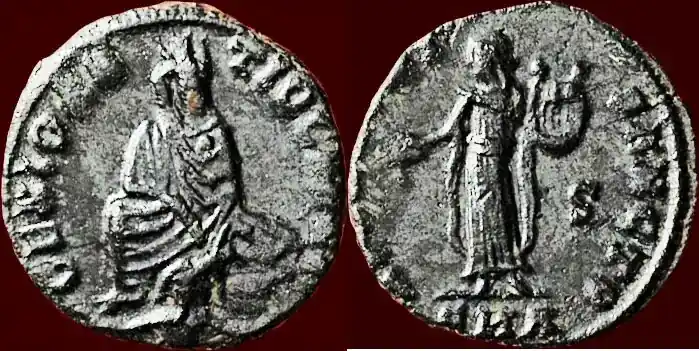
Beschreibung
Erhaltung: xf- | Abkürzungen
Katalognummer: Coh.1(Julianis II) | Kankelfitz 23 (Julianus II) | McAlee 170(f) | van Heesch (1993), pag.66, pl.11,3 | Sear 14927
Durchmesser: 15,00 mm
weight 1,80gr. | bronze Ø 15mm.
officina S
obv. Tyche of Antioch enthroned facing, river god swimming at her feet
GENIO ANTIOCHINI
rev. Apollo standing left holding patera and lyre, APOLLONI SANCTO,
S in field to right, SMA in exergue.
A vigorous persecution of the Christians had been initiated by Diocletianus in 303 AD, though Galerius was almost certainly the chief instigator of the imperial edict. The feect was largely felt in the East, where Galerius and Maximianus held sway in the years following Diocletianus abdication in 305. Although Galerius abandoned the policy of Christian persecution shortly before his death in 311, Maximinus Daja refused to extend religious toleration to the territories under his control and even increased the fervour of persecution for a further year and a half. Eventually by the end of 312 he came to realize that he was being politically outmanoeuvred by his western rivals on the question of religious policy, as evidenced by the edict on toleration promulgated by Constantine and Licinius at Milan early in 313. Maximinus finally renounced his persecution of the Christians but soon thereafter he was defeated in battle by Licinius, resulting in his political downfall. In the territories of Maximinus Daja a small group of civic coins where issued in the mints of Nicomedia, Antiochia and Alexandria. Formally these issues were attributed to the period of the pagan revival under Julianus II Apostate (360-363), however after recent studies now it seems clear that these issues belong to the time of Maximinus persecutions in 311-312 AD. Highly interesting historical coin and rare.
Coh.1(Julianis II) | Kankelfitz 23 (Julianus II) | McAlee 170(f) |
van Heesch (1993), pag.66, pl.11,3 | Sear 14927 R
xf-