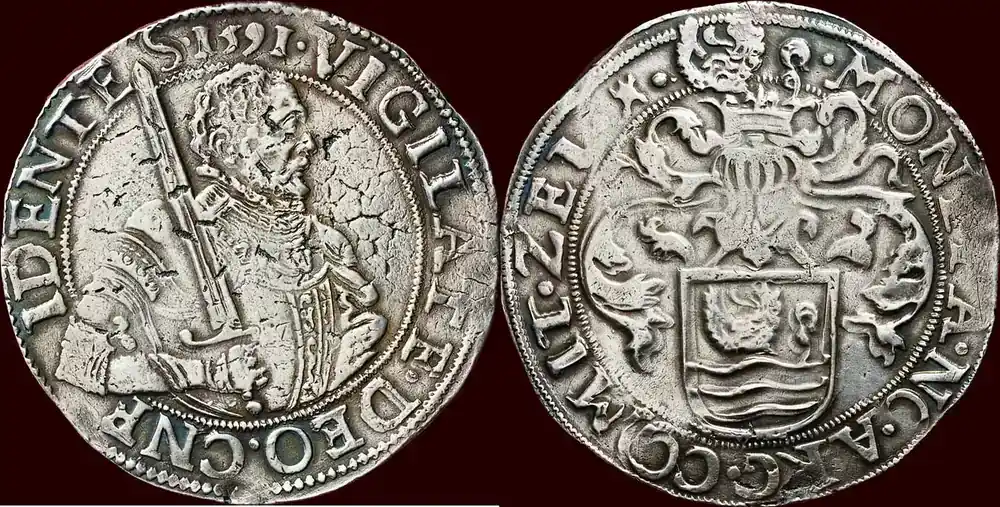
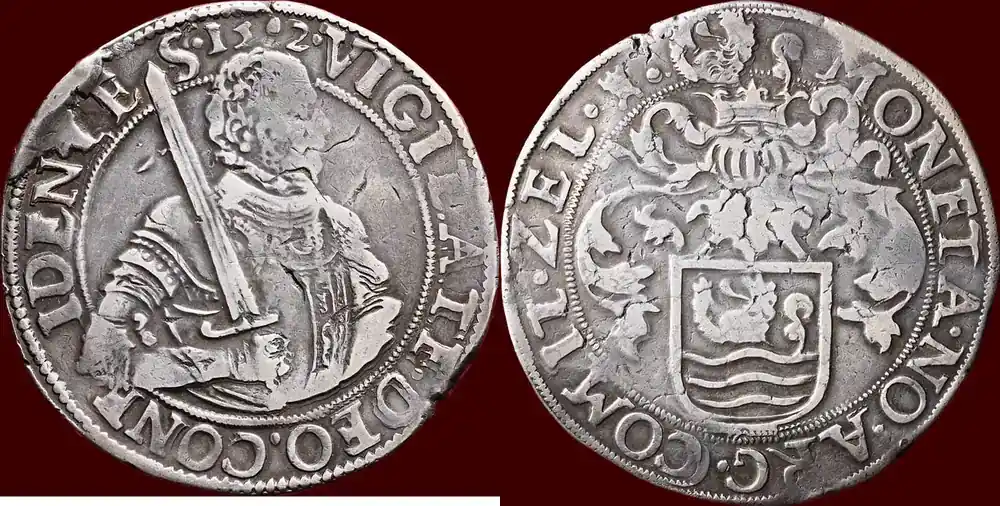
Beschreibung
Erhaltung: zfr- | Abkürzungen
Katalognummer: Prins Willem van Oranje
Gewicht: 28,23 g
Durchmesser: 41,00 mm
gewicht 28,23gr. | zilver Ø 41mm.
muntmeester Jacob Boreel
muntteken burcht
Dit munttype is geslagen naar voorbeeld van de Saksische talers, en was daarmee o.a. bestemd voor circulatie in het Duitse achterland en het Oostzeegebied. De afgebeelde edelman vertoond duidelijk de gelaatstrekken van de leider van de Opstand, Prins Willem van Oranje, hoewel diens naam niet genoemd wordt. Dit kon ook niet, want Willem van Oranje was immers geen soeverein vorst van de Nederlanden, alleen van Orange, en kon derhalve ook niet met naam en toenaam als muntheer vermeld worden op munten.
Coin with the portrait of William the Silent (1533-1584) William I, Prince of Orange (24 April 1533 10 July 1584), also widely known as William the Silent or William the Taciturn or more commonly known as William of Orange, was the main leader of the Dutch revolt against the Spanish Habsburgs that set off the Eighty Years War and resulted in the formal independence of the United Provinces in 1581. He was born in the House of Nassau as Count of Nassau-Dillenburg. He became Prince of Orange in 1544 and is thereby the founder of the branch House of Orange-Nassau and the ancestor of the monarchy of the Netherlands. A wealthy nobleman, William originally served the Habsburgs as a member of the court of Margaret of Parma, governor of the Spanish Netherlands. Unhappy with the centralisation of political power away from the local estates and with the Spanish persecution of Dutch Protestants, William joined the Dutch uprising and turned against his former masters. The most influential and politically capable of the rebels, he led the Dutch to several successes in the fight against the Spanish. Declared an outlaw by the Spanish king in 1580, he was assassinated by Balthasar Gérard (also written as Gerardts) in Delft in 1584.
De gehelmde rijksdaalder of prinsendaalder werd voor Zeeland slechts gedurende twee jaren aangemunt, namelijk in 1591 en 1592. Daarnaast werden in diezelfde jaren ook 1/2 gehelmde rijksdaalders of ½ prinsendaalders aangemunt. Van die jaren komen de stukken uit 1591 verreweg het meeste voor. Stukken met het jaartal 1592 zijn aanzienlijk zeldzamer.
Delmonte 926suppl. (R3) | Verkade 83.3 | HNPM.39
CNM.2.49.44 | Davenport 8875 RR
Zwaktes van de slag. Zeer zeldzaam.
zfr-