Beschreibung
Erhaltung: ss | Abkürzungen
Katalognummer: Elagabalus
Durchmesser: 18,00 mm
weight 2,72gr. | silver Ø 18mm.
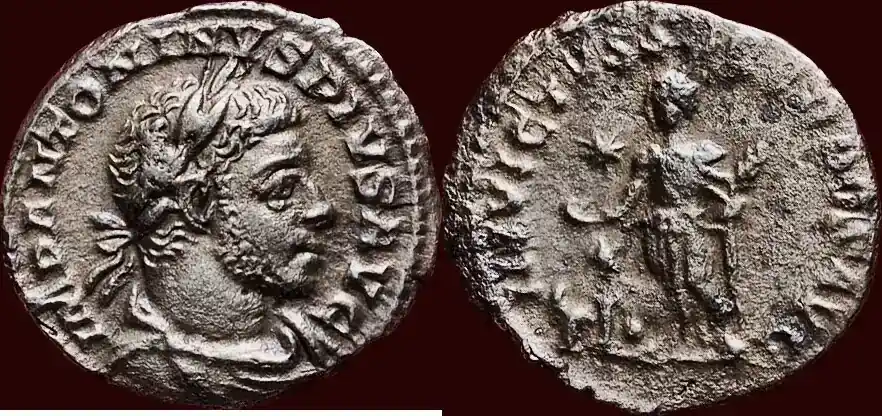
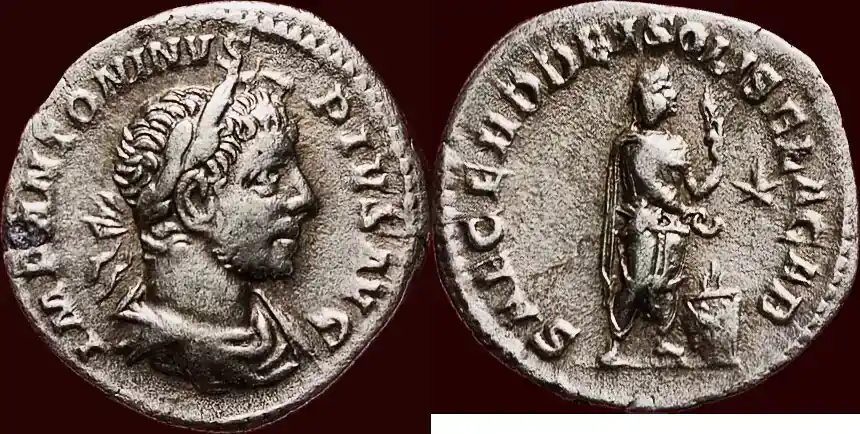
obv. Laureate and draped bust right, small horn over head,
surrounded by the legend IMP ANTONINVS PIVS AVG
rev. Elagabalus, in Syrian priestly robes, standing right,
sacrificing out of patera in right hand over lighted altar,
holding upright cypress branch in left hand, star in right field,
surrounded by the legend SAECERD DEI SOLIS ELAGAB
variant: with SAECERD instead of the usual SACERD. Not published
in the relevant reference literature and extremely rare as such.
Elagabalus was emperor from 218-222 AD, having been put in place by his grandmother Julia Maesa at just 14 years old, and was assassinated by the Praetorian Guard at the age of 18. Hes most well known for his allegedly deviant sexual behavior and for his devotion to the Eastern sun deity Elagabalus, where he got his posthumous nickname.
This denarius depicts on the obverse the head of Elagabalus and on the reverse the emperor offering a sacrifice. The inscription on the obverse refers to the emperor as imperator, or commander in chief of the army, Antoninus, Pius, and Augustus. The name Antoninus associated the emperor with his predecessor Caracalla of whom he pretended to be an illegitimate son. The inscription on the reverse refers to the emperor as summus sacerdos Augustus or the chief imperial priest. The reverse depicts the emperor, holding a patera with his right hand and a cypresse branch with his left hand. The emperor is depicted as dressed in a long tunic which has been usually interpreted as being of eastern origin a fact which would comfort Cassius Dios narrative when he writes that Elagabalus was frequently seen in public clad in the barbaric dress which the Syrian priests use (see Cassius Dio, Roman History LXXX.11). This fact has been however questioned by Lucinda Dirven who considers that Elagabaluss dress did not look like the conventional attire of Syrian priests but corresponded to the dress, probably of Germanic origin, that many emperors wore at the beginning of the third century to gain the favour of their soldiers.
The presence of a horn upon the head of the emperor on the obverse of the type has raised many questions regarding the nature of the object but also its meaning. In reality the shape of the object does not correspond exactly to that of a horn. A very plausible, but controversial, explanation that has been given to interpret this object has been formulated by Elke Krengel. She has argued that it would correspond to the end of a dried bulls penis which would have symbolized fertility and strength and whose aim would have been to ensure the transfer of the power of the Syrian sun god, El Gebal (Heliogabaal or Sol Invictus), to the high priest, here the emperor. These various elements show that, in the case of this specific issue, the emperor may perform the sacrifice for the Syrian god.
Cohen 246var. | RIC 131var. | cf. BMC 225note | Sear 7542var. RRR
vf