

Beschreibung
Erhaltung: ss+ | Abkürzungen
Katalognummer: Pietas
Durchmesser: 19,00 mm
weight 3,59gr. | silver Ø 19mm.
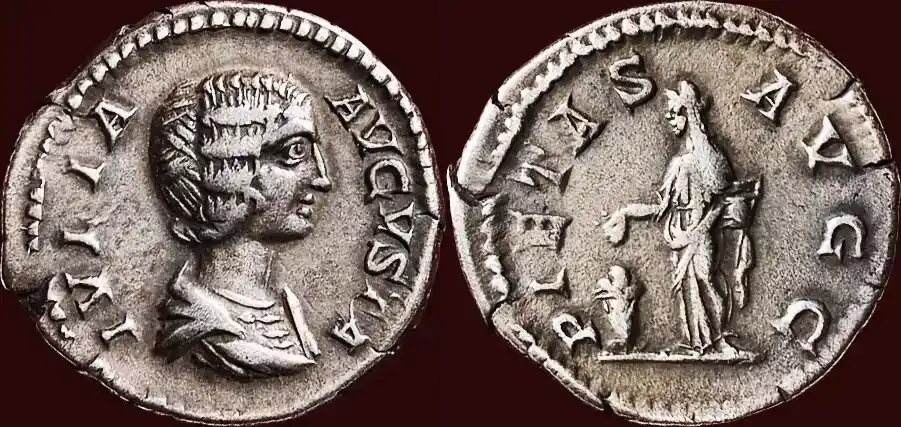
obv. Draped bust of Julia Domna right, hair waved and coiled at back,
surrounded by the legend IVLIA AVGVSTA
rev. Pietas standing left, holding patera, sacricifing at altar left,
surrounded by the legend PIETAS AVGG
Pietas, translated variously as duty, religiosity or religious behavior, loyalty, devotion, or filial piety, was one of the chief virtues among the ancient Romans. It was the distinguishing virtue of the founding hero Aeneas, who is often given the adjectival epithet pius (religious) throughout Virgils epic Aeneid. The sacred nature of pietas was embodied by the divine personification Pietas, a goddess often pictured on Roman coins. The Greek equivalent is Eusebeia. Pietas was represented on coin by cult objects, but also as a woman conducting a sacrifice by means of fire at an altar. In the imagery of sacrifice, libation, a ritual pouring of a liquid as an offering to a deity or spirit, or in memory of the dead, was the fundamental act that came to symbolize pietas. Pietas was the divine presence in everyday life that cautioned humans not to intrude on the realm of the gods. The Temple of Pietas at Rome was solemnly vowed by the plebeian consul and new man Manius Acilius Glabrio at the Battle of Thermopylae in 191 BC, where he defeated the emperor Antiochos the Great during the RomanSeleukid War. Completed by his son, it was erected at the northwest end of the Roman vegetable market (Forum Olitorium) near the Carmental Gate. It included a gold statue of the father, the first such statue of a Roman citizen in the city. Pietas was often depicted as goddess on the reverse of Roman Imperial coins, with women of the imperial family on the obverse, as an appropriate virtue to be attributed to them. Women of the Imperial family might be portrayed in art in the goddesss guise. Cohen 150 | RIC 572 | BMC 165, 62 | Sear 6600
attractive tone and good portrait
vf+