Beschreibung
Erhaltung: vf- | Abkürzungen
Katalognummer: The Koinon of Cyprus
Durchmesser: 33,00 mm
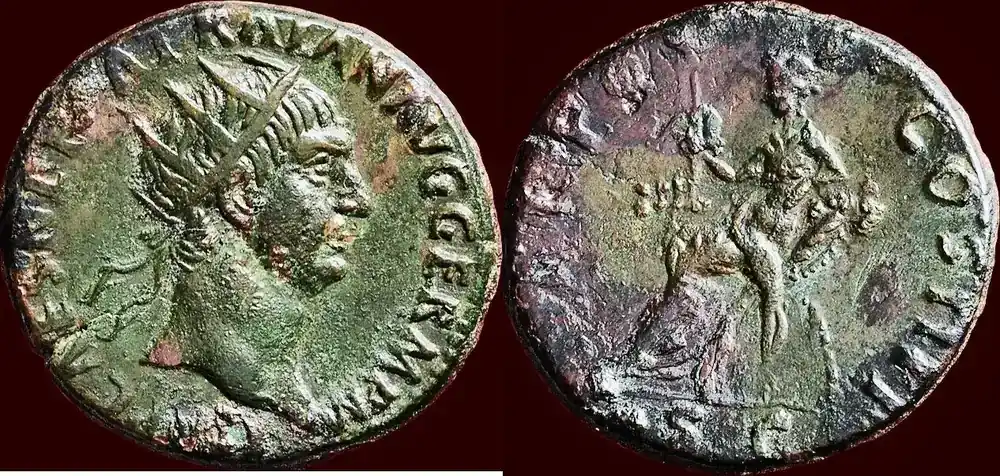
weight 25,05gr. | bronze Ø 33mm.
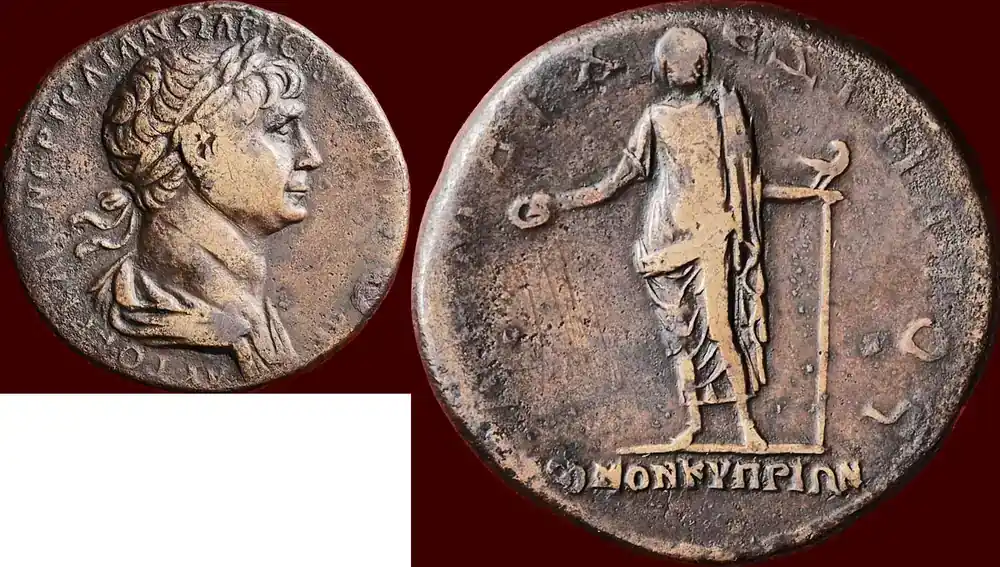
obv. Laurated and draped bust right
AYTOKP KAIC NP TRAIAN APICT CB EPM AK
rev. Zeus Salaminios standing facing, holding eagle-tipped scepter and patera,
around the legend HMAPX YATO, KOINON KYPIN in exergue
With this coin they followed the exact standard of the sestertius, in metal (orichalcum) weight and size. On this coin the cult of Zeus Salaminios is celebrated. This cult goes back to the early times of Teucer, the legendary founder of the city of Salamis. In Greek mythology, Teucer was the son of King Telamon of Salamis island and Hesione, daughter of King Laomedon of Troy. In the Hellenistic period a temple was built, dedicated to Zeus of Salamis. After the earthquakes of 76 and 77 AD, restoration of the city was begun under Vespasian and continued in the following decades. Also the temple of Zeus was rebuilt, even more impressive as it was before.Throughout this period, the citys ceremonial focus was the sanctuary of Zeus, and the image of Zeus appeared prominently on Roman coins as we can also see on this coin.
The Koinon of Cyprus In order to maintain some degree of autonomy after control of the island shifted to the Roman Empire, the various cities of Cyprus maintained a collective administrative body that reflected Hellenistic values introduced by the Ptolemaic dynasty at the end of the 4th century. Under the Ptolemies, the cities of Cyprus were allowed a degree of autonomy that was unfamiliar and somewhat unexpected. In order to maintain solidarity throughout the kingdom, the cities formed parliamentary committees with each other. Though the resulting confederation of Cypriot cities does not have an exact date of origin, the term Koinon (meaning common) began to appear on inscriptions around the middle of the 2nd century BC. Little is known about the exact function of the Koinon, though it seems to have been grounded in religion due to its initial associations with religious festivals at the Temple of Aphrodite, which was located at Palaipafos. The large number of people that gathered at the Temple likely realized a need for religious unity amongst all of them thus, the Koinon was formed to coordinate pancyprian religious festivals. Soon, the meetings of the Koinon began to stray from strictly religious matters and focus more on the social and political aspects of the country, including unifying the various districts and cities in terms of political representation. These assumptions are based on inscriptions on statues and other dedicatory epigraphical evidence around the island that implies that the Koinon had a presence all over Cyprus, as well as the money and influence to affect many different cities. Thus, the purpose of the Koinon shifted from autonomous parliamentary committees during the Hellenistic period to a religiously motivated pancyprian political body. The administrative privileges of the Koinon, by the end of the Roman period, included minting its own coins, participating in political relations with Rome, and bestowing honorary distinctions upon notable individuals. Inscriptions on statues, as previously mentioned, attest to this final function and indicate the fact that the Koinon was most likely a funded organization which received its dues in the form of an annual contribution from each city. The Koinon therefore maintained a great deal of power because it essentially controlled all forms of religion on the entirety of Cyprus. This power is later utilized to deify some of the Roman emperors starting with Augustus and ending with the dynasty of Septimius Severus. Known evidence in the form of inscriptions and dedications indicates with certainty that the emperors Augustus, Caracalla, Titus, Tiberius, Trajan, Vespasian, Claudius, Nero, and Septimius Severus and his succeeding dynasty all formed imperial cults that were represented on Cyprus. These cults were mostly formed by the emperors in an attempt to solidify their right to rule and gain religious support as peers of the Roman pantheon of gods.
BMC 40 | SNG.Copenhagen 83 | Forrer 7752 | SNG.Schweiz II, 1733 | Sear GIC- RR
Highly interesting and very rare large bronze coin.
vf-