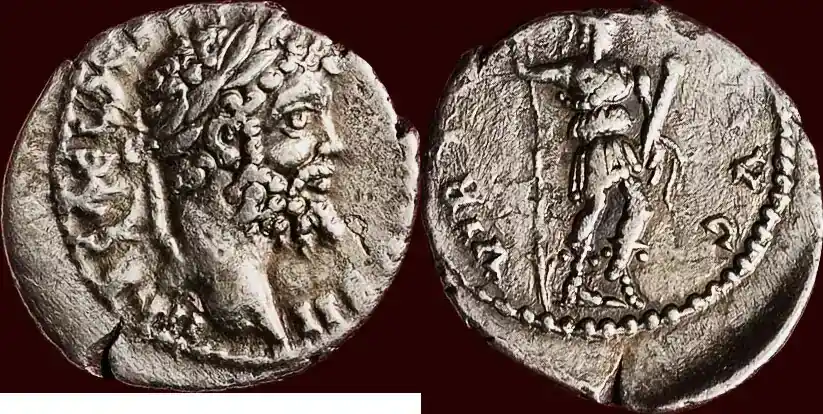
Beschreibung
Erhaltung: ss | Abkürzungen
Katalognummer: Emesa
Durchmesser: 18,00 mm
weight 2,48gr. | silver Ø 18mm.
obv. Laureate head of Septimius right, surrounded
by the legend IMP CAE L SEP SEV PERT AVG COS II
rev. Virtus, helmeted, draped, standing left, holding spear in
right hand and parazonium in left hand, surrounded by the legend
VIRTVTE AVG
Emesa (modern Homs, Syria) did not emerge into the historical record until the 1st century BC at the time of the Seleukids. It later became the capital of a kingdom ruled by the Emesene dynasty who gave the city its name. The city of Emesa grew to prominence after the new-found wealth of the Emesene dynasty, governed first by one of the sons of Sampsiceramus I, Iamblichus I who made it the kingdoms capital. The Emesene proved their loyalty to Rome once more when they aided Caius Julius Caesar in his siege of Alexandria in 48 BC, by sending him army detachments. Subsequently, they became embroiled in the Roman Civil War between the rebelling Markus Antonius and the pro-Caesar Octavianus. Relations with the Roman government grew closer when King Sohaemus inherited the kingship. Under him, Emesa sent the Roman military a regular levy of archers and assisted them in their siege of Jerusalem in 70. Sohaemus had died in 73. According to Maurice Sartre, the dynasty was very likely deprived of its kingdom, which was annexed to the Roman province of Syria, between 72 and the date of the construction of the Tomb of Sampsigeramus (7879). Under the Romans, Emesa began to show attributes of a Greek city-state and traces of Roman town planning still remain. Its transformation into a major city was completed under the reign of Emperor Antoninus Pius (138161) when Emesa began to mint coins. By the 3rd century, it grew prosperous and well integrated into the Roman Orient. This was partly due to the marriage of Emperor Lucius Septimius Severus to a woman from a family of notables based in Emesa. Caracalla and Elagabalus each promoted Emesa to the rank of a colonia and granted ius Italicum to it. Elagabalus served as the high priest at the Temple of El-Gebal, the local Arab sun god. He brought the image of this god, a conical black stone (Baetyl), to the Elagabalium in Rome. Emesa also grew wealthy because it formed a link in the eastern trade funnelled through Palmyra however, this dependence also caused the citys downfall when Palmyra sank to insignificance in the 4th century. Nonetheless, Emesa at this time had grown to rank with the important cities of Tyre, Sidon, Beirut, and Damascus. It also continued to retain local significance, because it was the market center for the surrounding villages. The city remained a strong center of paganism, because of the Temple of El-Gabal. After one of his victories over Zenobia, Emperor Aurelian visited the city to pay thanks to the deity. Due to the strength of the pagan sun cult in Emesa (the sun god El-Gabal), Christians initially did not settle in the city. Eusebius writes that Silvanus, the citys first bishop, had no jurisdiction over the city, but the surrounding villages. He was executed by Emperor Julianus and succeeded by Bishop Antonius, the first bishop to settle Emesa. By the 5th century, Christianity was well established under the Byzantine Empire however, few ancient Christian inscriptions exist in Homs today. Under the Byzantines, the city became an important center for Eastern Christianity. Initially a diocese, Emesa was given the status of ecclesiastical metropolis after the discovery of John the Baptists head in a nearby cave in 452. In 637 AD, the Rashidun army, led by Khalid ibn al-Walid, captured Emesa peacefully because its inhabitants agreed to pay a substantial ransom of 71,000 to 170,000 dinars. In the centuries that followed, the city would be ruled by many different Muslim leaders and was also besieged many times by the Byzantines and the Crusaders. Cohen 771 | RIC 431 | BMC 99, 403 | Sear 6390 R
Light off-centre strike. Rare.
vf