Beschreibung
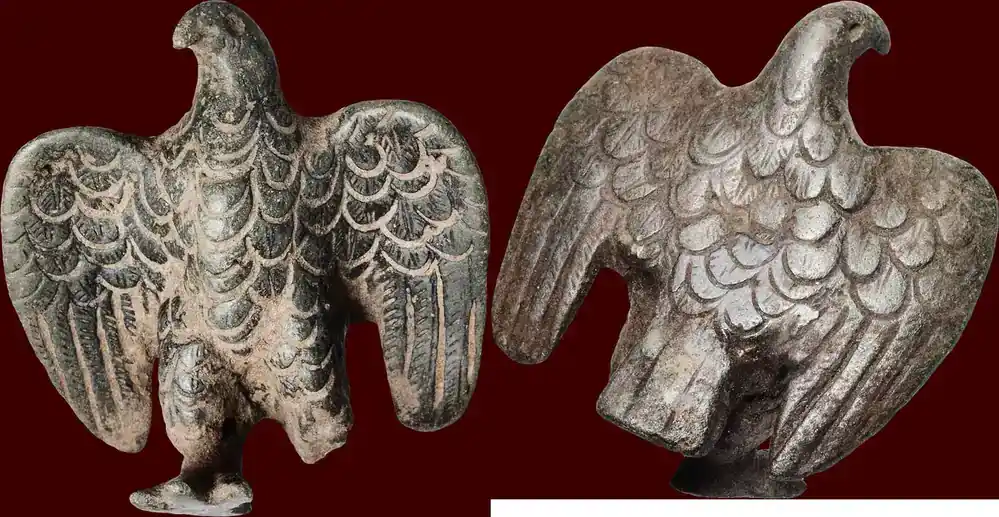
Erhaltung: Imperial eagle standing facing with spread wings. A wonderful and fierce cast-bronze figurine of a standing eagle with a raised | Abkürzungen
Katalognummer: Provenance: French private collection.
height 55mm. | width 50mm. | weight 78,05gr.
Imperial eagle standing facing with spread wings. A wonderful and fierce cast-bronze figurine of a standing eagle with a raised head turned to its left. Fine feather detailing on the chest and wings.
In Greek mythology, the eagle is associated with the supreme god Zeus (Jupiter to the Romans) and in that sense it symbolizes the highest power. The eagle was a highly-symbolic animal among the Roman military and was a great symbol of pride and victory in the eyes of the legions. Known as aquila in Latin, the eagle was a representation of honor, victory, and cohesiveness within a legion. One member of each legion was referred to as an aquilifer, or eagle-bearer, as it was their primary duty to carry and protect that legions designated eagle standard. If ever an aquila was lost or stolen, it was the primary obligation of the aquilifer to go to any lengths to recover the standard and see to its safe return. Losing an eagle standard was considered a grave omen for its respective legion and would typically lead to distrust and paranoia among the legionaries. To quote a piece of historical fiction set in Roman Britain entitled The Eagle of the Ninth (Rosemary Sutcliff, 1954), Eagle lost, honor lost honor lost, all lost.
Provenance: French private collection.
Acquired at the French art marked in the 1960s.
attractive greenbrown patina
left paw missing, otherwise intact