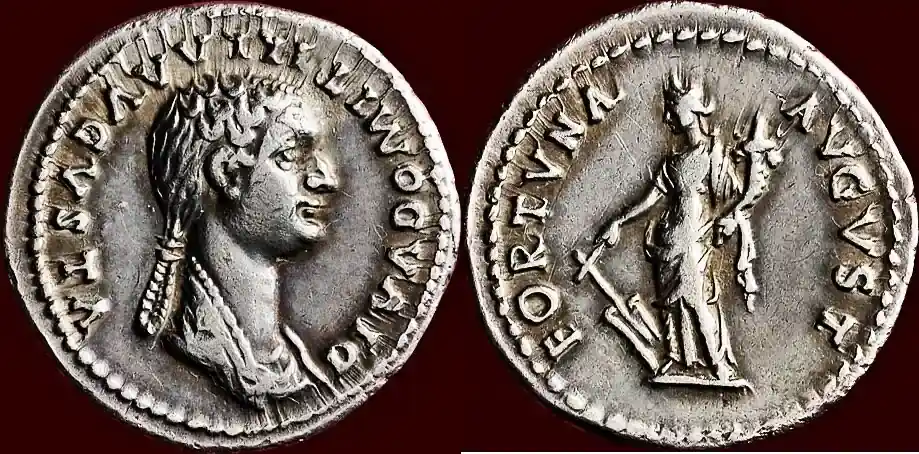
Beschreibung
Erhaltung: xf-/ ss+ | Abkürzungen
Katalognummer: Cohen 3 | RIC 157 | BMC 137 | Sear 2888
Durchmesser: 19,00 mm
weight 3,34gr. | silver Ø 19mm.
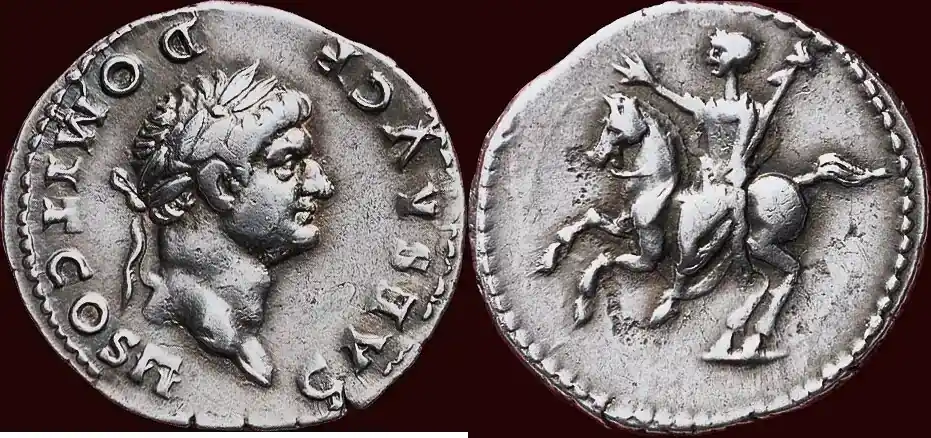
obv. Bust of Domitilla right, hair in long plait in back,
surrounded by the legend DIVA DOMITILLA AVGVSTA
rev. Fortuna standing left, holding rudder and cornucopiae,
surrounded by the legend FORTVNA AVGVST
Flavia Domitilla the Elder was born circa 2 AD in Sabratha to Italic colonists who had moved there during the reign of Augustus. She was the daughter of Flavius Liberalis, a humble quaestors clerk from Ferentium (modern Ferento), a country town in Italy. Before her marriage, she was a formal mistress to Statilius Capella, an equestrian. It was scandalously rumoured that she possessed only Latin status, until her father Liberalis produced evidence of her Roman citizenship. Vespasianus married her around AD 38. They had three known children, Domitilla the Younger and the emperors Titus and Domitian, but they might have had four other children who died in childhood. She died before Vespasianus became emperor. We know very little about Domitillas life. Historians have paid little attention to her. And that was the fate of the vast majority of women throughout history, including first-century women. It wasnt that they didnt live good, satisfying lives. We have to hope they did. But they left no record that endured beyond their deaths.which unfortunately came very early to most of them. From the three emperors of the famous Flavian dynastyVespasianus, Titus and Domitianusthere are still many contemporary sculptures showing their strong, masculine faces. But we know very few sculptures of the Flavian women and are mainly dependent on their images on coins. Both Titus and Domitianus had coins minted in honor of their deceased mother. Only on Domitianus pieces, a denarius, is she depicted with her portrait. On the reverse Fortuna is depicted, the goddess of fortune and luck.The profile portrait on the denarius offered here is fascinating. With her classic Roman nose and jutting chin, Flavia Domitilla bears great resemblance to her sons Titus and Domitianus. Even Flavia Domitillas name betrays the anonymity of her life. This particular womans mother was named Flavia Domitilla, and her daughter was named Flavia Domitilla. Typical for the time. Women took feminine versions of their fathers and husbands names. If there was more than one daughter in the family, they were all named the same.set apart from each another only as prima (first), secunda (second), tertia (third, and so on. Emperor Vespasianus wife and daughter were distinguished from one another as Flavia Domitilla Major (elder) and Flavia Domitilla Minor (younger). Cohen 3 | RIC 157 | BMC 137 | Sear 2888 RRR
Wonderful specimen with very attractive portrait.
Hard to find this nice. Extremely rare.
xf-/vf+